


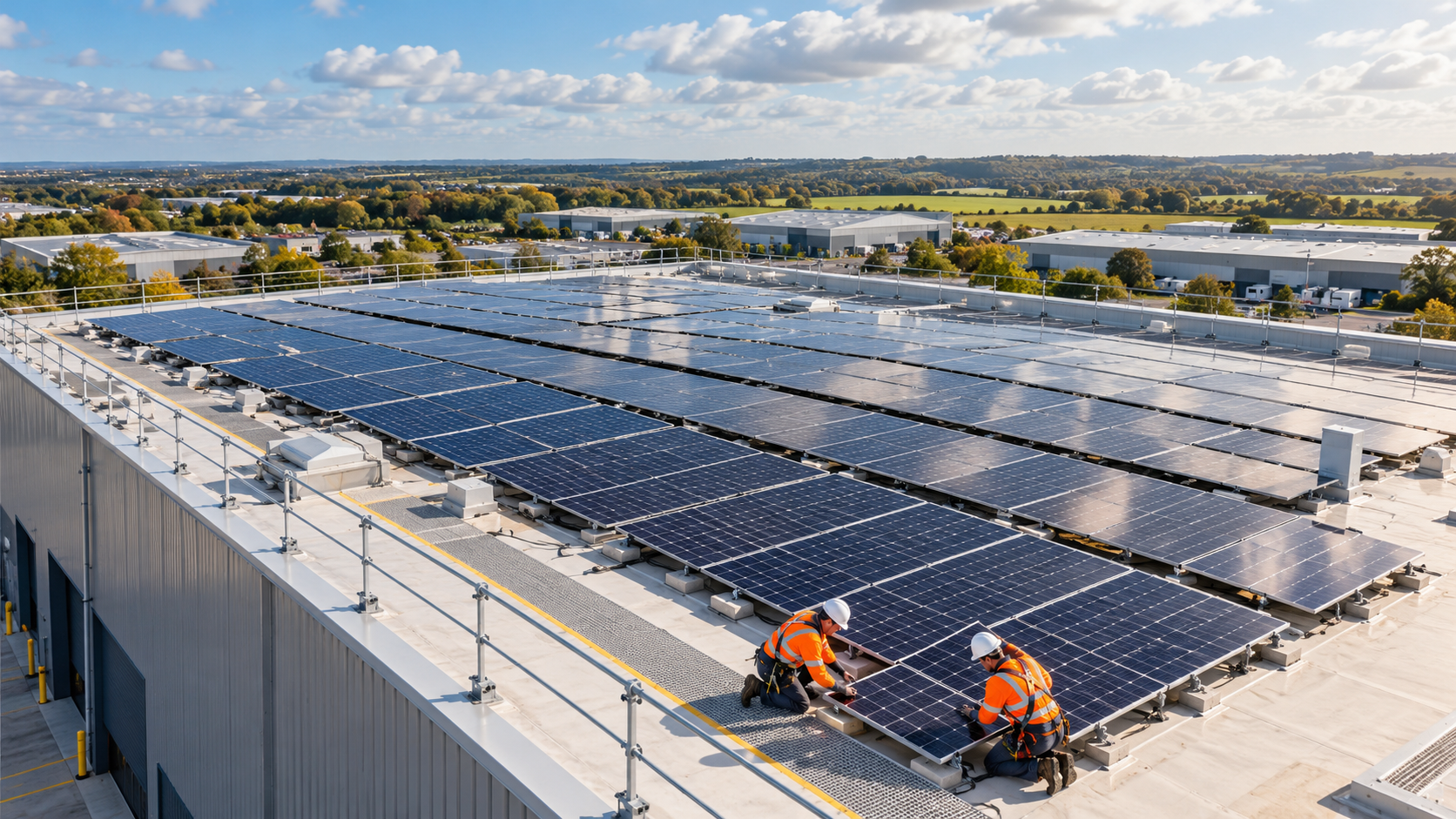
Your warehouse roof remains unused while the power bill keeps coming. Commercial solar panel installation can change that, and it follows seven steps- a site survey, system design, grid connection approval, finance and permissions, installation, commissioning, and monitoring. Solar panels for business can cut the electricity you buy from the grid and earn income from the surplus you export. Most commercial systems need DNO approval under G99. That can take weeks or months, so start early.
If you are planning a commercial solar power installation for a warehouse, factory, office, retail unit or farm building, this guide covers the process, planning rules, cost factors and ways to pay.
Call Now – 07774990920
Key Takeaways
- Commercial solar panel installation runs in seven steps, from the site survey to monitoring.
- Most commercial systems need G99 approval from the DNO before they connect. Waits run from weeks to months, so apply early.
- In England, roof-mounted solar is often permitted development. Listed buildings are excluded, and larger systems need prior approval from the council.
- Cost depends on system size, roof condition and access, electrical work and grid works. There is no single standard price.
- You can buy, lease or sign a PPA. Most businesses have no national grant, and support is mainly tax-based.
- Check the roof first. Structural capacity is for a suitably qualified structural engineer, and any PV installation is subject to structural assessment and system design.
Solar Panels for Business: Why It’s Worth Doing

Solar panels for business work best where a building uses a lot of power during the day. Every unit your panels make, and your site uses, is a unit you do not buy from your supplier.
- Lower electricity bills: On-site power replaces grid power.
- Protection from price rises: Part of your supply no longer follows the unit rate.
- Export income: Surplus power can earn payments through the Smart Export Guarantee.
- Tax and rates: Solar equipment may qualify for the Annual Investment Allowance. In England, on-site renewables are exempt from business rates until 31 March 2035. Check both with your accountant.
- Brand and ESG value: Lower site emissions help with reporting and customer questions.
With commercial solar, the roof comes first. Panels stay on that roof for the life of the system, so its condition matters.
How Commercial Solar Panel Installation Works
The process runs in seven steps. Some overlap, and grid approval often sets the pace.

1. Site survey and assessment
Your installer reviews 12 months of bills and, if available, half-hourly meter data. This shows when you use power, which sets the right system size. The survey also checks roof condition and age, access, shading and orientation. Structural capacity is for a suitably qualified structural engineer to confirm. If the roof is near the end of its life, repair or refurbishment often comes first.
2. System design and quote
The designer lays out panels, inverters, cabling, and mounting for your roof and your load. A clear quote itemizes panels, inverters, mounting, cabling, scaffolding, monitoring, grid fees, and commissioning. It should also state expected yearly output and the assumptions behind it, so you can compare quotes fairly.
3. Grid connection (DNO)
Your local Distribution Network Operator (DNO) must know about every system. G98 covers small systems up to 16A per phase of inverter output. You notify the DNO rather than wait for approval. Most commercial systems are bigger and need G99, which requires DNO approval before you connect. The DNO has 45 working days to respond to a complete application, and real waits can run from weeks to months. The test is the inverter’s export capacity, not the panel size. So, apply early.
4. Finance and permissions
Choose how you will pay: buy, lease or sign a power purchase agreement (PPA). Then check planning, landlord consent and your duties under the Construction (Design and Management) Regulations 2015 (CDM). The HSE treats a business as a commercial client, so you must make sure the work is planned and managed safely.
5. Installation
Crews set up scaffolding or edge protection, fix the mounting system, lay the panels, then run DC and AC cabling to the inverters and switchgear. Roof safety is important as well. The HSE says falls through fragile surfaces, such as fiber-cement roofs and rooflights, account for 22% of fatal falls from height in construction. It advises treating every roof as fragile until a competent person confirms otherwise. Works can often be phased to minimise disruption to ongoing site operations.
6. Testing and commissioning
Engineers test the circuits, check isolation and safety systems, and confirm the inverter settings match the DNO approval. You then receive handover documents. Keep them safe. Insurers, future buyers and export payments may all need them.
7. Monitoring and maintenance
Monitoring software shows live output and flags faults. Check it regularly and book an annual inspection. Details are in the maintenance section below.
Also Read –Common Causes of a Leaking Roof in Commercial Buildings
Do You Need Planning Permission for Commercial Solar Panels?
Often, no full application is needed. In England, roof-mounted solar on non-domestic buildings is usually permitted development under national planning rules. Limits apply, so confirm with your local planning authority first.
- Panels must stick out no more than 0.2m on a pitched roof, rise no more than 1m above a flat roof, and sit at least 1m from the roof edge.
- Listed buildings and scheduled monuments are excluded.
- Systems that are not microgeneration need prior approval from the council, usually decided within 56 days.
- Conservation areas do not bar roof solar on their own.
- Ground-mounted arrays usually need full planning permission. Car park canopies follow a separate prior approval route.
- These rules cover England only. Wales and Scotland differ.
How Solar Panels for Commercial Buildings Work

Panels turn daylight into direct current (DC) electricity. An inverter converts it to alternating current (AC), the type your building uses. Your site uses that power first. Any excess flows to the grid.
An export meter records what you send out. That reading matters because it is how suppliers calculate Smart Export Guarantee payments.
Most sites keep their existing meter, fusebox and cabling. A larger system may require a supply capacity upgrade, so ask your installer to check this at the design stage.
Types of Commercial Solar PV Panels and Systems
Roof-mounted, ground-mounted and carports

Roof-mounted systems suit most commercial units. Flat roofs often use ballasted frames that sit on the surface and are held down with weights. Pitched roofs use rails or hooks fixed through the covering. Ground-mounted arrays suit sites with spare land. Car park canopies add shelter while they generate power.
Panel types and battery storage
Monocrystalline panels are the usual choice today. They give more output per square metre than polycrystalline, which helps where roof space is tight. Compare manufacturers on warranty terms and track record.
Batteries make sense when you make more power than you use at midday and need it later. They add cost and complexity, so ask for the case with and without storage.
What Affects Commercial Solar Power Installation Cost
Searching for commercial solar panels UK cost figures shows wide ranges because every site differs. These are the factors that move the price:
- System size and layout
- Roof type, condition and access, including scaffolding and edge protection
- Mounting system
- Panel and inverter choice
- Electrical work, including switchgear and any supply upgrade
- DNO application and any network works it requires
- Battery storage
- Roof repairs needed before panels go on
Note: All cost and pricing figures discussed are indicative only. Actual repair/refurbishment costs depend upon specification, access, insulation, roof condition, safety requirements, and other project-specific factors.
Buy, Lease or PPA: How to Pay for Commercial Solar
| Option | Upfront outlay | Who owns the system | What you gain | Main risk |
| Buy outright | Highest | You | All savings and export income. | You carry performance and upkeep. |
| Lease or asset finance | Low or none | Depends on the contractor | Savings, less the payments | Payments continue regardless of output |
| PPA | None | The provider | Power at an agreed rate per unit. | Long contract tied to your roof. |
Check the roof before you sign anything. A PPA provider or lender will want a sound roof for the full contract term. Also ask what happens if you sell or lease the building.
Grants and Tax Relief for Commercial Solar
If you want grants for solar panels on commercial buildings in the UK, the honest answer is that most businesses have no single national grant. Support is mainly tax-based.
The Annual Investment Allowance lets eligible businesses deduct qualifying equipment spending from profits. Whether solar qualifies, and how much relief you get, depends on your circumstances, so ask your accountant. England also exempts on-site renewables from business rates until 31 March 2035.
Local or sector schemes appear from time to time. Check with your council or trade body before you assume solar panels for business grants are unavailable.
Also Read – Roof Repair Cost
Commercial Solar Payback and ROI
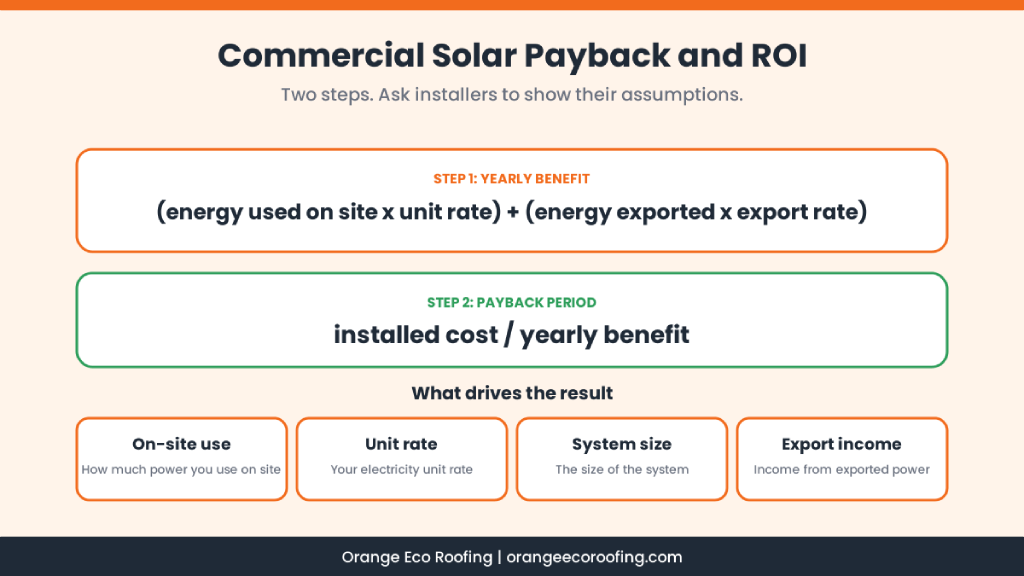
Payback is the time it takes for your savings and income to cover what you paid. Work it out in two steps.
Yearly benefit = (energy used on site × unit rate) + (energy exported × export rate)
Payback period = installed cost ÷ yearly benefit
Four things drive the result- how much power you use on site, your electricity unit rate, system size, and export income. A site that uses most of its power in daylight hours usually pays back faster than one that exports most of it. Ask installers to show their assumptions, and distrust any payback figure that hides them.
Selling Excess Solar Power: Smart Export Guarantee for Business
The Smart Export Guarantee (SEG) pays you for the solar power you export. Ofgem publishes the rules, and the scheme covers solar PV up to 5MW in Great Britain.
Suppliers set their own rates, which must be at least zero, and pay based on export meter readings. You can choose a SEG supplier that is different from your electricity supplier, so compare offers. Rates change, so check them before you sign. Ask your installer whether another route, such as a PPA, would suit your site better.
What to Ask Your Solar Installer
Ask every installer the same questions so you can compare them fairly. Good answers are specific and in writing.
- Who handles the G99 application, and what happens if the DNO asks for changes?
- What does the quote include, and what does it leave out?
- Which accreditations and insurance does the installer hold?
- What are the panel and inverter warranty terms, and who honours them?
- What yearly output do you expect, and what degradation assumptions sit behind it?
- Who has checked the roof and structure, and what did they find?
- How will you manage roof safety, fragile surfaces and site access, and can works be phased around our operations?
- What monitoring and maintenance support is on offer?
Commercial Solar Maintenance and Monitoring
Solar needs little day-to-day attention, but it is not maintenance-free. Remote monitoring shows output and alerts you to faults. Panels may need cleaning where dust or bird droppings build up. Book an annual inspection that covers the panels, mounting, cabling, and inverters. Inverters often wear out sooner than panels, so ask for a replacement timeline. Keep the roof in view too. Any later roof work means lifting and refitting panels.
How to Choose a Commercial Solar Installation Company
When you compare commercial solar power installation companies, look for clear accreditations, experience on buildings like yours, references you can contact and a written scope. If you search for commercial solar power installation near me, check that the firm works in your area and will visit the site.
The roof under the panels matters as much as the panels. Orange Eco handles commercial and industrial roofing in London, Kent and the South East, including roofing works and solar-ready roof refurbishment. Its sister company, Smart Green Energy Ltd, handles specialist MCS PV electrical supply, installation and commissioning.
If your roof is ageing, ask about refurbishment planned with future panels in mind. “Solar-ready” is not a fixed standard, so ask exactly what it covers. Any PV installation is subject to structural assessment and system design.
Frequently Asked Questions
What is the “20 rule” for solar panels?
There is no official rule by that name. People use the phrase in different ways. Some mean a sizing buffer added to the system. Others mean the panels’ efficiency. Ask your installer what they mean before you rely on it.
Do I need a battery with commercial solar?
No. Many systems run without one. A battery helps when you generate more than you use in the day and need power later. Ask for your usage to be modelled with and without storage.
Can I sell surplus power?
Yes. The Smart Export Guarantee pays for solar PV exports up to 5MW in Great Britain. Suppliers set the rates, so compare offers and check the terms.
Can I install solar on an old roof?
Possibly, but check the roof first. A suitably qualified structural engineer must confirm it can carry the load. Repair or refurbishment often comes before panels.
Next Steps
Commercial solar panel installation runs from survey to commissioning, and grid approval often sets the pace. Start with your roof and your energy data. To discuss your roof’s condition and refurbishment planned with future panels in mind, speak to Orange Eco.




Leave A Comment